Design and review note: These original written instructions have been reviewed for stitch arithmetic and construction logic, but have not been physically crocheted or sample-tested. Measurements are planning estimates, not verified finished sizes. Existing images are illustrative, not a photographic record of this exact design. Make a sample and check the relevant fit, shape and attachments before use.
Original written design — unworked draft. These directions were written independently. Stitch arithmetic can be checked on paper, but no physical sample has been made. Dimensions and yarn needs are planning estimates, not verified results. Make and measure a sample before promising fit, appearance or durability. Existing illustrative pictures may not show this exact construction.
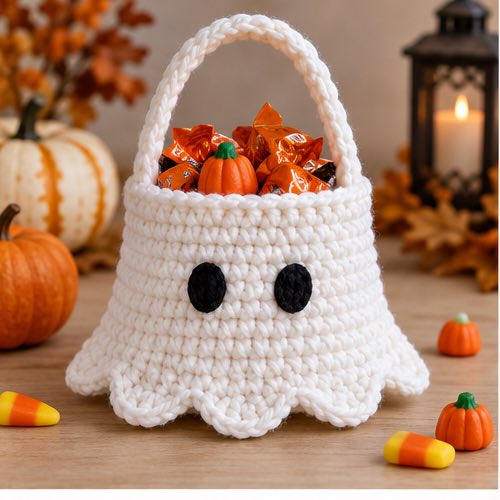
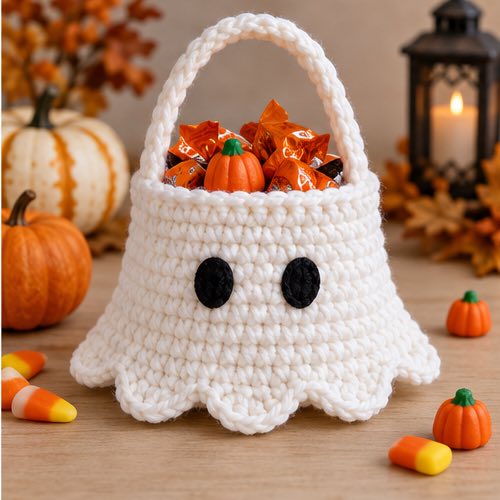
Make a small, rectangular ghost-face treat bag from two flat panels and two short handles. This version deliberately uses a simple closed rectangular base rather than an unsupported wavy base. Embroider the face; do not use detachable eyes.
Materials and size planning
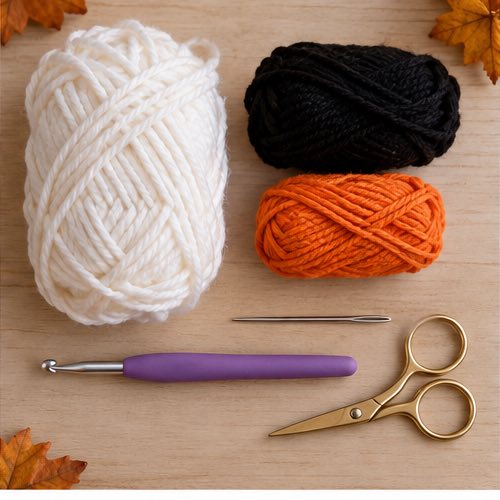
Use smooth white cotton or cotton-blend yarn with black embroidery yarn, a 5 mm starting hook, yarn needle, scissors and markers. Choose yarn and hook together to obtain firm fabric. Target flat gauge: 16 sc and 24 rows per 10 cm on a washed swatch. Each 28-stitch by 42-row panel calculates to 17.5 × 17.5 cm, approximately 7 inches square before seams. Seam take-up reduces the usable inside space. Yarn consumption has not been measured; supply matching yarn for two panels, two handles and a swatch.
US terms and counting rules
ch = chain; sc = single crochet; sl st = slip stitch; st/sts = stitch/stitches; inc = 2 sc in one stitch; dec = sc two stitches together. For a dec, insert through the next stitch, pull up a loop, repeat in the following stitch, yarn over and draw through all three loops. It consumes two stitches and makes one. Work both loops unless stated. For flat rows, ch 1 and turn before the next row; that chain never counts. Work the first sc into the first real stitch. In continuous rounds, do not join or turn; mark the first stitch and move the marker each round. Repeat counts exclude finishing slip stitches.
Make two panels
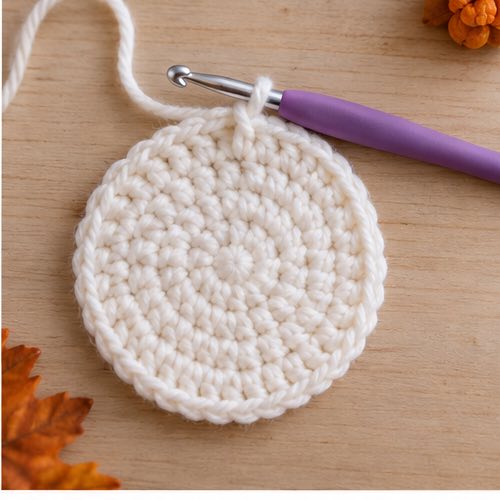
Ch 29 for each panel.
| Row or round | Direction | End count |
|---|---|---|
| 1 | Sc in second ch from hook and every remaining ch. | 28 |
| 2–42 | Ch 1, turn; sc in every stitch. Each of these 41 rows has the same count. | 28 |
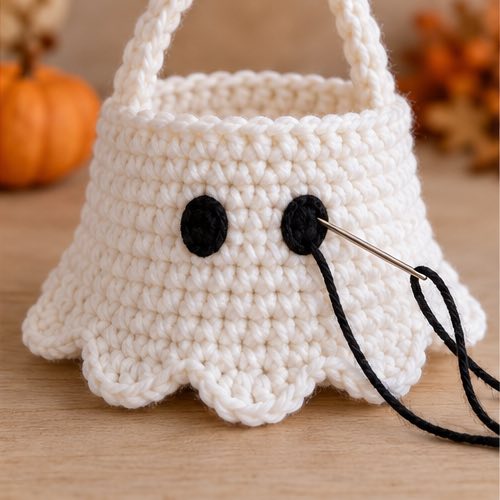
Fasten off. Mark the top of both panels: row 42 is the opening and the foundation is the bottom. On the front panel only, embroider two flat oval eyes centered approximately over stitches 9 and 20 at row 31; embroider a small mouth centered between stitches 14 and 15 around row 25. Use several short embroidery stitches, not long loose loops. Secure tails on the wrong side.
Seam the bag
Place wrong sides together, with row 42 at the top of both panels. Sew the two foundation edges together through 28 matched chain positions. Sew each side through 42 matched row-end positions, working bottom to top. Do not sew the row-42 edges together. Turn inside out if you want the seams inside. Check that all three closed edges have no opening; this bag is for wrapped treats only, not loose small food.
Make two handles
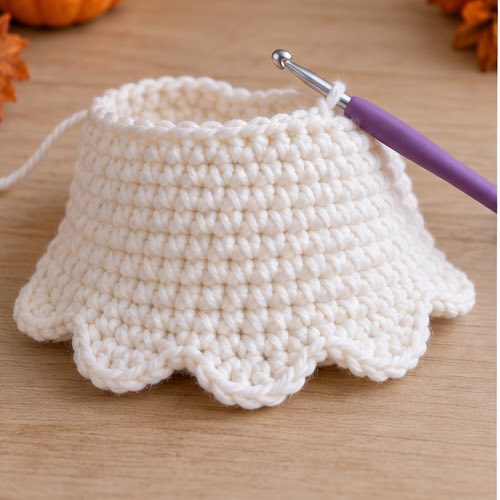
For each handle, ch 7. Row 1: sc from second ch across = 6 sc. Rows 2–30: ch 1, turn, 6 sc. Fasten off with a long sewing tail. At the target gauge each handle is approximately 3.75 × 12.5 cm before attachment. On one panel, sew the first handle's six-stitch end across top-edge stitches 4–9 and its other end across stitches 20–25. Overlap each end about two rows down the panel and stitch around the overlap, then across it. Repeat on the other panel with the second handle. Do not accidentally sew the front to the back. Both handles form matching arches above the opening.
Checks and troubleshooting
29 chains minus the skipped chain gives 28 sc; 42 rows are made on each panel. Each handle has 30 rows of 6 sc. If the top edges do not align, recount the rows before seaming. If a seam stretches open, resew it through sound fabric rather than only the outermost loose loop. Check handles empty first, then with only a few lightweight wrapped treats; no load rating is established. Keep handles and yarn away from very young children and pets; do not hang the bag around a neck.
Questions about this project
Can I make a scalloped ghost bottom?
Not by changing the closed foundation seam in this draft. A separate decorative trim would require its own sample and count review; keep this version rectangular.
Why does my handle look too short?
Its attachment overlaps reduce the exposed arch. Measure the actual strap and test the opening before permanently sewing both ends.
Do I need a lining?
The draft has no lining instructions. Use only wrapped items larger than any fabric gaps; a separately fitted fabric lining needs its own sewing measurements.
Before calling the pattern tested
Record the yarn brand, actual quantity, washed gauge and finished dimensions from a real sample. Check every seam and photograph these exact steps. Mathematical review is not a practical crochet test or product safety certification.
More Crochet Projects & Guides
When you are ready for another project, explore this crochet maple leaf pattern and keep building your seasonal crochet collection one clear project at a time.