Design and review note: These original written instructions have been reviewed for stitch arithmetic and construction logic, but have not been physically crocheted or sample-tested. Measurements are planning estimates, not verified finished sizes. Existing images are illustrative, not a photographic record of this exact design. Make a sample and check the relevant fit, shape and attachments before use.
Original written design — unworked draft. These directions were written independently. Stitch arithmetic can be checked on paper, but no physical sample has been made. Dimensions and yarn needs are planning estimates, not verified results. Make and measure a sample before promising fit, appearance or durability. Existing illustrative pictures may not show this exact construction.
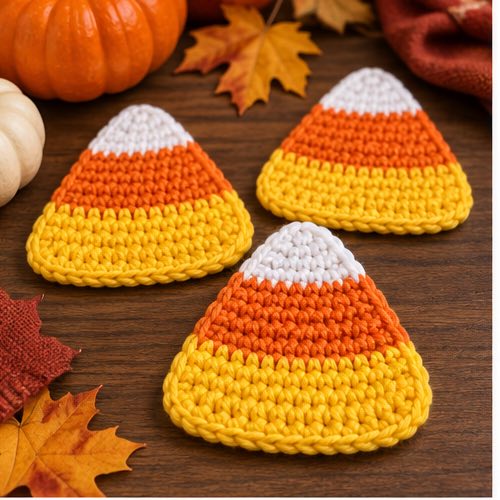
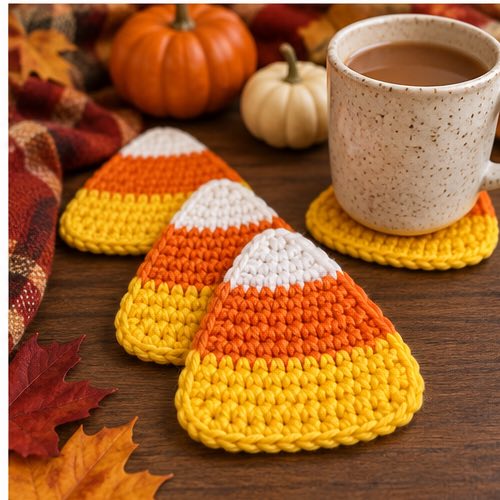
This flat candy-corn coaster is worked from a blunt white tip through orange to a broad yellow base. Alternating increase and straight rows create the triangle. Use cotton for a functional coaster; do not treat it as insulation for hot cookware.
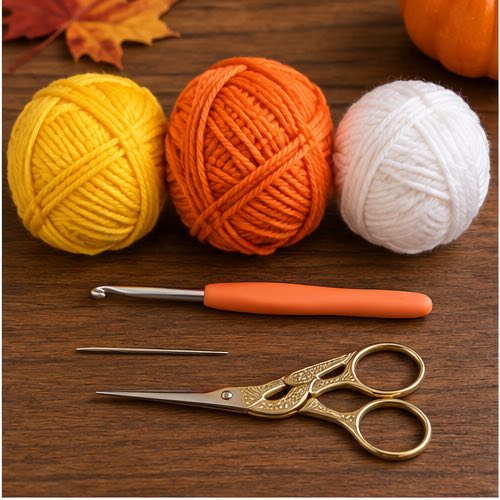
Materials and calculated size
Smooth worsted cotton in white, orange and yellow; 4 mm starting hook; needle, scissors and markers. Target flat gauge: 20 sc and 24 rows per 10 cm on a washed, dry swatch. The 22-stitch base and 20 rows calculate to approximately 11 × 8.3 cm before any blocking. These are estimates; actual glass support and flatness need a sample. Yarn consumption has not been measured.
US terms and counting rules
ch = chain; sc = single crochet; sl st = slip stitch; st/sts = stitch/stitches; inc = 2 sc in one stitch; dec = sc two stitches together. For a dec, insert through the next stitch, pull up a loop, repeat in the following stitch, yarn over and draw through all three loops. It consumes two stitches and makes one. Work both loops unless stated. For flat rows, ch 1 and turn before the next row; that chain never counts. Work the first sc into the first real stitch. In continuous rounds, do not join or turn; mark the first stitch and move the marker each round. Repeat counts exclude finishing slip stitches.
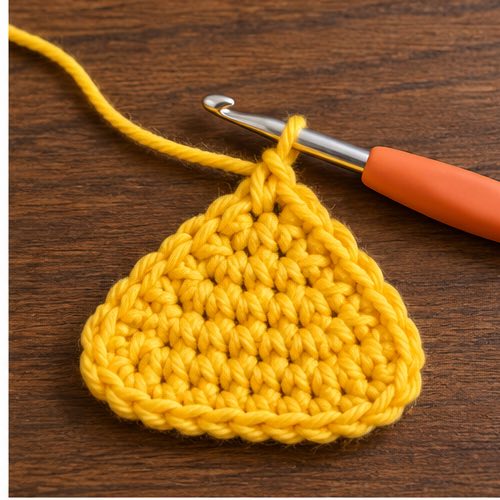
Triangle, white tip upward
In white, ch 3. For every row after row 1, ch 1 and turn. On increase rows, the first and last stitches each receive two sc; all stitches between receive one.
| Row or round | Direction | End count |
|---|---|---|
| 1, white | Sc in second ch and last ch. | 2 |
| 2, white | Inc in both stitches. | 4 |
| 3, white | Sc across. | 4 |
| 4, white | Inc, 2 sc, inc. | 6 |
| 5, orange | Sc across. | 6 |
| 6, orange | Inc, 4 sc, inc. | 8 |
| 7, orange | Sc across. | 8 |
| 8, orange | Inc, 6 sc, inc. | 10 |
| 9, orange | Sc across. | 10 |
| 10, orange | Inc, 8 sc, inc. | 12 |
| 11, orange | Sc across. | 12 |
| 12, orange | Inc, 10 sc, inc. | 14 |
| 13, yellow | Sc across. | 14 |
| 14, yellow | Inc, 12 sc, inc. | 16 |
| 15, yellow | Sc across. | 16 |
| 16, yellow | Inc, 14 sc, inc. | 18 |
| 17, yellow | Sc across. | 18 |
| 18, yellow | Inc, 16 sc, inc. | 20 |
| 19, yellow | Sc across. | 20 |
| 20, yellow | Inc, 18 sc, inc. | 22 |
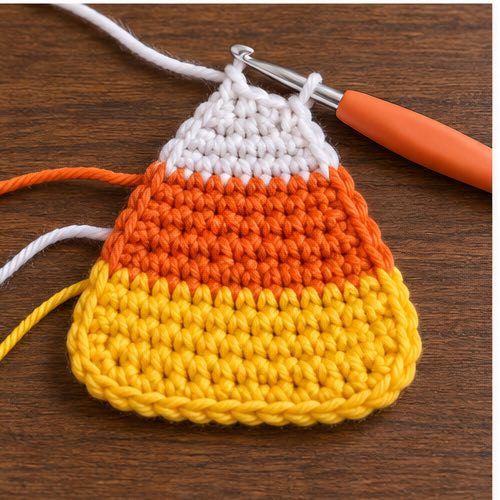
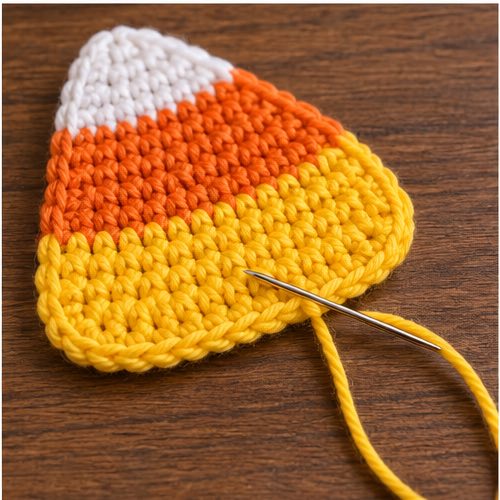
Change to orange on the final pull-through of row 4; change to yellow on the final pull-through of row 12. Fasten off after row 20. No border is required or included. Weave all ends along the wrong side in two directions without leaving lumps under the cup. Wet-shape only as permitted by the yarn label, then dry flat without stretching the triangle out of proportion.
Count and use checks
Ten increase rows add two stitches each: 2 + 10 × 2 = 22. All odd-numbered rows after the first keep the previous count. If one edge leans, check that you did not miss the final real stitch or accidentally work in a turning chain. Put the dry coaster on a level table and check the intended glass rests entirely within its stable flat area. A triangle with the stated maximum dimensions does not support every glass equally well. If it curls or tips a glass, do not use it until the sample has been corrected.
Care and safety
Follow the cotton label. Keep color-change tails secured and check colorfastness before placing it on light furniture. This is a beverage coaster, not a potholder, trivet, flame barrier or child teether.
Questions about this project
Why is the tip blunt?
The first row has two sc, giving a small stable top rather than a needle-sharp point. Do not add an uncounted chain as a third stitch.
Where are the color boundaries?
White occupies rows 1–4, orange rows 5–12 and yellow rows 13–20. Change on the preceding row's final pull-through for a clean next-row color.
Why does my mug overhang the narrow end?
A triangular coaster has less usable space near its tip. Center the glass on the broad flat area and test stability; measured width alone is not proof of support.
Before calling the pattern tested
Record the yarn brand, actual quantity, washed gauge and finished dimensions from a real sample. Check every seam and photograph these exact steps. Mathematical review is not a practical crochet test or product safety certification.
More Crochet Projects & Guides
When you are ready for another project, explore this crochet maple leaf pattern and keep building your seasonal crochet collection one clear project at a time.