Design and review note: These original written instructions have been reviewed for stitch arithmetic and construction logic, but have not been physically crocheted or sample-tested. Measurements are planning estimates, not verified finished sizes. Existing images are illustrative, not a photographic record of this exact design. Make a sample and check the relevant fit, shape and attachments before use.
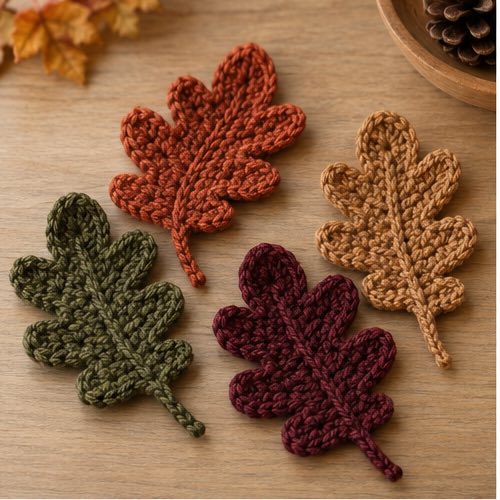
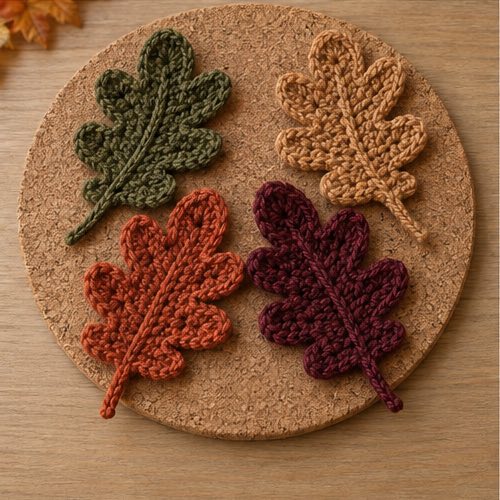
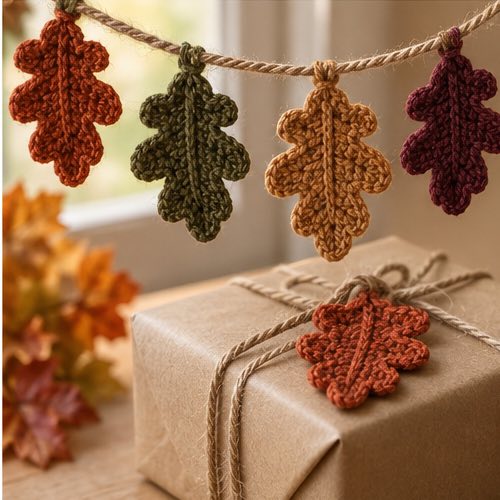
Make a small oak-inspired leaf applique with three rounded lobes along each side and a narrow stem. This original design is worked around a foundation chain, then given a scalloped outline. It is a decorative interpretation rather than a botanically exact leaf.
Pattern status: The written stitch consumption and totals have been checked mathematically. This design has not been crocheted as a physical sample. Shape, gauge, yarn usage and finished dimensions remain unverified; the photographs accompanying this page are inspiration, not evidence of a tested result.
Materials and size planning
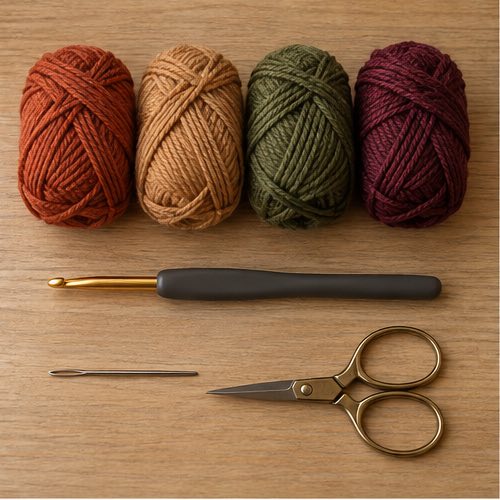
- Smooth worsted cotton in one autumn color.
- 4 mm hook, or a comfortable hook for your yarn.
- Yarn needle, scissors and two removable markers.
Make a small single-crochet swatch first. No measured gauge or exact finished size is promised. Use the same yarn and hook for a matching set; a heavier yarn changes both the length and width. Choose a firm but flexible fabric and weigh your first completed leaf if you need a yarn estimate.
US abbreviations and notes
Ch = chain; sc = single crochet; dc = double crochet; sl st = slip stitch; st = stitch. A group in parentheses is worked into one stitch. Turning chains are not stitches. Work through both loops unless directed otherwise. The foundation is worked on both sides: do not turn the work as though starting a flat row.
Foundation oval: 32 stitches
Ch 16. Beginning in the second chain from the hook, sc in each of the next 14 chains. Work 3 sc in the last chain. Rotate the foundation to work along its unused underside: sc in each of the next 13 chains, then work 2 sc in the underside of the first chain used at the beginning. You now have 32 sc: 14 + 3 + 13 + 2. Sl st to the first sc; the joining slip stitch does not count.
Number the sc around from 1 to 32 and put markers in stitches 16 and 32. Stitch 16 is the tip anchor; stitch 32 is the stem anchor. Do not count the joining slip stitch as a base stitch.
Shape six rounded lobes
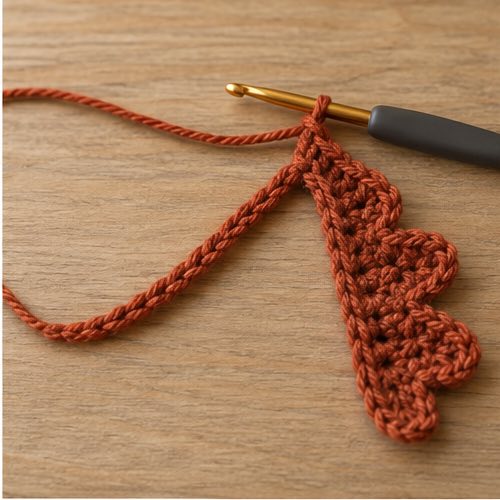
Ch 1, which does not count. Across the first 15 base stitches, repeat this five-stitch sequence three times: sl st in the next stitch; 3 dc in the next stitch; sl st in the next stitch; sc in the next stitch; sl st in the next stitch. Each repeat consumes 5 base stitches and produces 7 edge stitches.
Sc in marked base stitch 16. Across base stitches 17–31, repeat the mirrored five-stitch sequence three times: sl st in the next stitch; sc in the next stitch; sl st in the next stitch; 3 dc in the next stitch; sl st in the next stitch. Sl st in marked base stitch 32. There are 44 edge stitches: 21 + 1 + 21 + 1. Do not add an extra stitch into the joining slip stitch.
Add the stem
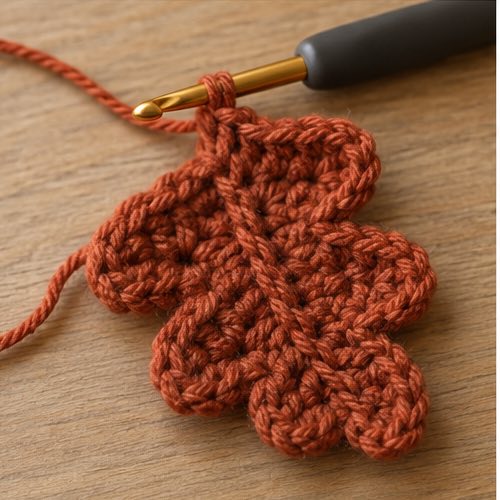
From the stem anchor, ch 6. Sl st in the second chain from the hook and in the remaining 4 chains: 5 slip stitches. Sl st once into the same stem anchor to attach the return. Fasten off, leaving enough yarn to weave securely. The stem is separate from the 44-stitch leaf-edge count.
Finish and attach
Weave the tails through the back of the foundation, changing direction before trimming. Dampen cotton lightly and arrange the six lobes on a towel. Let dry flat without stretching the chain spine. If using acrylic, follow its yarn-label blocking advice; do not apply a hot iron. Sew the applique to a finished project with small stitches through its back, rather than pulling every scallop tight against the background.
Troubleshooting
The edge ends early: recount the 32 base stitches, excluding the joining slip stitch. Both side sequences use exactly 15 stitches. The lobes crowd: check that each 3-dc group is in one base stitch, not three separate stitches. A little cupping may reflect individual tension; blocking is not a substitute for correcting a missed stitch. The stem twists: work its return slip stitches loosely and check that all five chains were used.
Questions about this leaf
Can I make four lobes on each side?
Not by adding another repeat to this foundation: every base stitch is already allocated. Make this six-lobe version first rather than improvising an extra group into the tip.
Where should a garland cord pass?
Sew a separate short loop to the back near the stem anchor and thread the cord through it. Do not rely on one outer double crochet to bear the leaf's weight.
Can I sew it onto a washable blanket?
Use a fiber compatible with the blanket's care instructions and test for color bleeding first. Secure the stem as well as the body so it cannot snag.
Safety and care
This is decoration, not a tested toy component. Keep garland cords and loose leaves away from babies and pets. Wash according to the chosen yarn label and dry flat.
Final Thoughts
Complete one leaf, assess its shape and note your yarn and hook before making a set. Keep the stem and lobe instructions together when you record any personal adjustments.
More Crochet Projects & Guides
Explore the crochet maple leaf pattern for another autumn motif, then browse the site for simple projects that build confidence one clear step at a time.