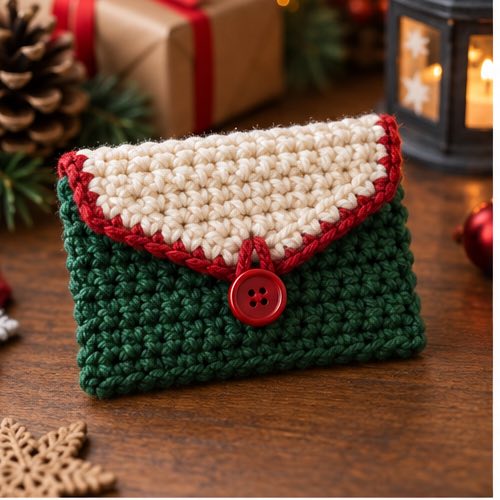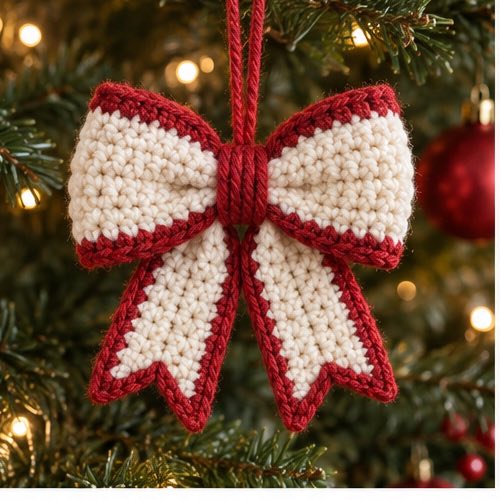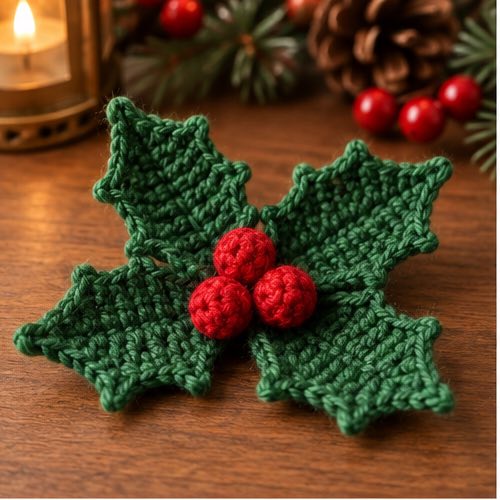
Design and review note: These original written instructions have been reviewed for stitch arithmetic and construction logic, but have not been physically crocheted or sample-tested. Measurements are planning estimates, not verified finished sizes. Existing images are illustrative, not a photographic record of this exact design. Make a sample and check the relevant fit, shape and attachments before use.
Original written design — unworked draft. These directions were written independently. Stitch arithmetic can be checked on paper, but no physical sample has been made. Dimensions and yarn needs are planning estimates, not verified results. Make and measure a sample before promising fit, appearance or durability. Existing illustrative pictures may not show this exact construction.
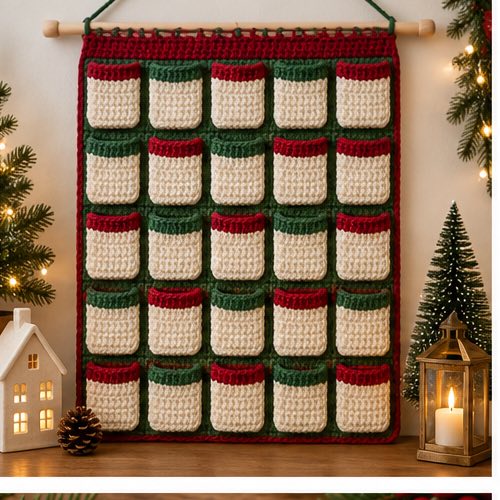
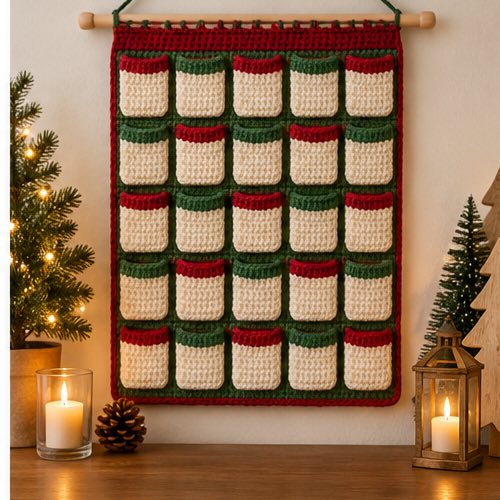
This compact countdown uses twelve flat pockets sewn to a separate rectangular backing. It has a defined layout rather than unspecified pockets joined into a grid. Make the twelve-pocket version first; a twenty-four-pocket calendar needs a separately enlarged and load-tested backing.
Materials and size planning
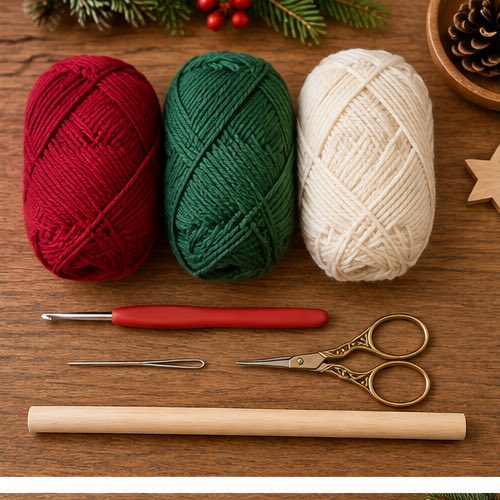
Use smooth worsted cotton in cream for the backing, red and green for pockets, a 4 mm starting hook, needle, scissors, removable markers and a smooth dowel at least 24 cm long. Target flat washed gauge: 20 sc and 24 rows per 10 cm. The backing calculates to 20 × 30 cm; each pocket to 4 × 5 cm before seams. Plan yarn for a 40-stitch by 72-row backing, twelve 8-stitch by 12-row pockets, four hanging tabs and a swatch. Actual quantity and weight capacity remain unmeasured.
US terms and counting rules
ch = chain; sc = single crochet; sl st = slip stitch; st/sts = stitch/stitches; inc = 2 sc in one stitch; dec = sc two stitches together. For a dec, insert through the next stitch, pull up a loop, repeat in the following stitch, yarn over and draw through all three loops. It consumes two stitches and makes one. Work both loops unless stated. For flat rows, ch 1 and turn before the next row; that chain never counts. Work the first sc into the first real stitch. In continuous rounds, do not join or turn; mark the first stitch and move the marker each round. Repeat counts exclude finishing slip stitches.
Backing
Ch 41 in cream. Row 1: sc from second chain across (40 sc). Rows 2–72: ch 1, turn, 40 sc each row. Fasten off. Foundation is the bottom, row 72 the top. Mark the front; pocket sewing must not cross the tops of the pockets.
Twelve pockets
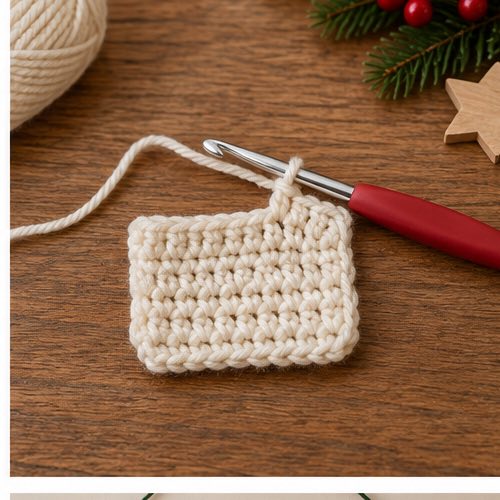
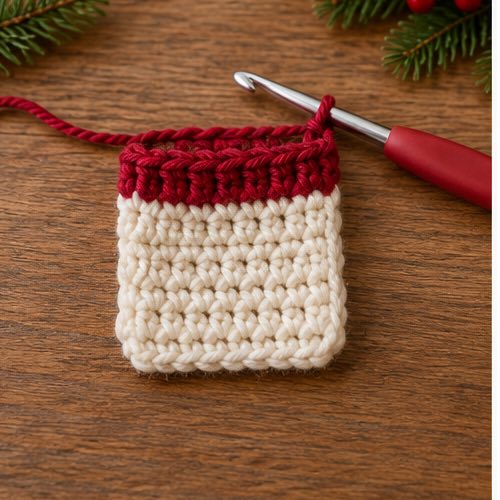
Make six red and six green. For each, ch 9. Row 1: sc from second chain across (8 sc). Rows 2–12: ch 1, turn, 8 sc each row. Fasten off leaving approximately 40 cm for sewing; use additional yarn if required. These are single panels, not folded pouches; the backing forms each pocket's rear wall.
Exact layout and sewing
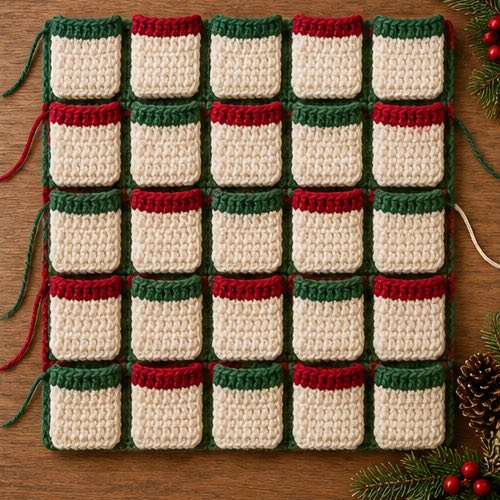
Place four columns across the backing. Pocket stitches 1–8 align with backing columns 2–9, 12–19, 22–29 and 32–39 respectively. Place three rows vertically: the pocket foundation edges align with backing row 4, row 24 and row 44. Each pocket's row 12 lies eleven backing row intervals above its foundation, so its top aligns approximately with backing row 15, 35 or 55. Verify with markers on the actual fabric; stitch and row directions must run the same way.
Sew each bottom through eight matched stitch positions. Sew both sides through twelve paired row-end positions into the marked backing column, including the upper corners. Leave the entire row-12 top edge open. Do not sew through the pocket's interior from front to back. Remove markers and insert a small paper note to confirm every opening works. The nominal horizontal gaps are two backing stitches and the vertical gaps are eight intervening backing rows.
Four top tabs and hanger
Each tab: ch 5; row 1 sc across from second chain (4 sc); rows 2–12 ch 1, turn, 4 sc. Make four, nominally 2 × 5 cm each. Fold each around the dowel. Sew both four-stitch ends to the upper backing across columns 3–6, 13–16, 25–28 and 35–38, over backing rows 70–72. Check the actual dowel fits with slack; lengthen tabs by whole four-stitch rows before sewing if necessary. Secure all tabs through multiple backing stitches. Tie a strong separate hanging cord to the two protruding dowel ends and check balance.
Numbering, checks and safety
Embroider numbers 1–12 with flat stitches before attaching pockets, or use paper numbers for display away from children. Do not add loose beads, buttons or clips. Confirm all backing rows have 40 stitches and every pocket row has 8. Fill only with lightweight notes initially; no safe weight limit is established. Mount above children's and pets' reach, keep hanging cords inaccessible, and check the wall hook and seams. Do not let children pull the pockets or climb for them.
Questions about this project
Can I turn this into a twenty-four-day calendar?
Not by crowding another twelve pockets onto this backing. A larger panel, dowel and tested attachment layout are needed.
Why are my pockets smaller inside?
Their 4 × 5 cm dimensions are external calculations. Side seams and yarn thickness reduce the opening and usable cavity. Test an actual note before sewing all twelve.
Can I crochet the numbers into the pockets?
This draft uses plain sc panels with optional embroidery. Tapestry charts and their altered gauge are not included.
Before calling the pattern tested
Record the yarn brand, actual quantity, washed gauge and finished dimensions from a real sample. Check every seam and photograph these exact steps. Mathematical review is not a practical crochet test or product safety certification.
More Crochet Projects & Guides
When you are ready for another project, explore this crochet maple leaf pattern and keep building your seasonal crochet collection one clear project at a time.